
The National Living Wage has risen nearly £4 since April 2020. But behind that headline figure lies a more complicated story about compression, retention, and the true cost of keeping pace.
14th April 2025
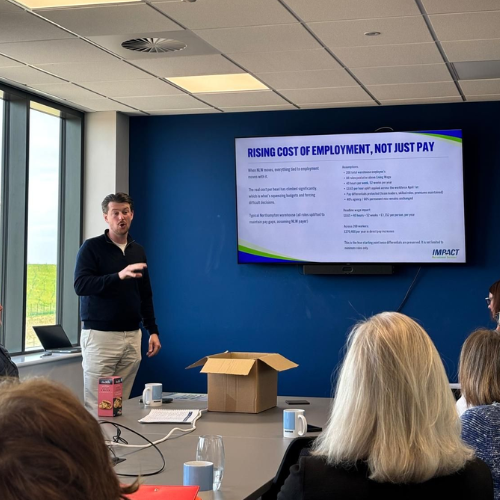
At a recent Northamptonshire Logistics Forum, Matthew Hospon, our Operations Manager shared findings on what rapidly rising National Living Wage (NLW) rates are really doing to businesses across the region. The message was straightforward: while wages have technically kept pace with inflation, the knock-on effects for employers (hidden costs, eroded pay differentials, and a tightening labour market) are anything but.
The conversation is one we’re having every week with clients. So, we’ve pulled the key insights together here, because this isn’t just a topic for industry forums. It matters to every logistics and warehousing business operating in Northamptonshire right now.
Wages are up. Workers still feel worse off.
Since April 2020, the National Living Wage has risen by nearly £4 per hour, and it’s worth remembering that the original purpose of a minimum wage was to protect living standards, not to drive wage growth alongside inflation. But the pace of increase since COVID has changed the landscape dramatically. We’re no longer talking about gradual uplift. We’re talking about a baseline that is rising faster than many businesses can sustainably absorb.
And yet, purchasing power tells a different story for workers. Due to inflation over the same period, £100 in 2020 now has the buying power of less than £80 today. With recent petrol price increases adding further pressure, workers at shop floor level in warehousing and logistics feel they have less money in their pocket even as their headline pay has gone up.
“Whilst technically wages haven’t fallen behind inflation, you could argue that for the people working at shop floor level in warehouse logistics, wages have fallen behind the inflationary pressure everybody is under.”
For employers, this creates a difficult dynamic. You’re paying more, your employment costs have risen, and yet your workforce still feels the squeeze. That disconnect matters because it affects motivation, loyalty, and ultimately, retention.
The hidden cost nobody is budgeting for
Labour is the dominant cost line for logistics businesses, and if you’re running or leading one, you’ll know that instinctively. At Impact Recruitment, labour accounted for 71% of our cost line in a recent month. For a high-volume logistics operation, that proportion is unlikely to be very different.
When the NLW rises, it doesn’t just affect the employees sitting at the minimum. Every related employment cost moves with it. National Insurance contributions, pension obligations, and holiday pay all increase overnight. There is no return on that spend. It’s simply a higher floor.
This also applies to businesses using agency labour. It’s worth remembering that when you use an agency, you’re not just paying a small margin on top – all of those employment costs are built into the gross wage rate. Every NLW increase flows directly through to your agency spend too.
To illustrate the scale of the direct impact: an assumptive study of a Northamptonshire business with 200 employees on or near the living wage found that maintaining existing pay differentials (simply paying people the same relative amount as before) could add over £200,000 to the annual wage bill from the April increase alone.
£4 NLW increase since April 2020
<£80 Purchasing power of £100 from 2020
£200k+ Estimated additional annual cost for a 200-person logistics business
9 in 10 Employers reporting recruitment difficulties
The pay compression problem
Here’s where the real structural challenge lies. The rapid progression of the living wage has made it increasingly difficult for employers to maintain meaningful pay differentials between entry-level and supervisory or management roles.
Consider a real Northampton logistics business: in April 2020, entry-level workers were paid £9.74 per hour, already above the living wage at the time. Supervisors were earning £15.38. Post the latest April increase, that business became a living wage payer at entry level, but supervisory pay increased proportionally far less. The differential has been eroded. And with it, the financial incentive for a good warehouse operative to step up into a team leader or management role.
Why would someone take on extra responsibility, accountability, and stress for a pay packet that barely differs from the person they’re managing?
This compression isn’t limited to management grades. It has spread across the skills ladder. Twelve years ago in this industry, there was a very clear difference in pay between an entry-level worker and a forklift truck driver, for example. People would actively pursue their FLT licence knowing there was a £2 to £3 per hour uplift waiting for them. That distinction has largely disappeared. Inventory controllers, stock controllers, and operators with distinct skill sets are increasingly being graded into the same general pay tiers. The financial return on gaining skills and taking on more responsibility has narrowed significantly.
Premium payers are no longer premium
There’s a related shift happening at the other end of the market. Businesses that have historically been regarded as strong-paying employers in the region (those that attracted and retained talent by paying well above the living wage) are finding that gap has dramatically narrowed.
“There has never been a better time to be a living wage payer. The problem is, being a living wage payer used to mean something different.”
Employers who were once known across Northamptonshire as the go-to places for well-paid work are now sitting much closer to baseline. If you can genuinely pay well above living wage, you will still have the pick of the available workforce. But more and more businesses are finding themselves in and around the living wage band and once you’re there, your experienced operators become fair game for any competitor who can offer something slightly better.
Signing bonuses and peak-period incentives can help with short-term attraction. During COVID, some businesses were offering joining bonuses of up to £3,000. There is nothing wrong with using these as an attraction tool, but they are not a sustainable retention strategy. They get people through the door; they don’t keep them there.
More work, less labour
The labour market picture in Northamptonshire is challenging in its own right. There are more work opportunities in the county than ever before, but less available labour to fill them. Employment reached near-peak levels during COVID, driven by the surge in demand across logistics and e-commerce, and businesses held on to their best people as a result. That tight pool has not meaningfully grown since.
While 2024 was a difficult year for volumes across the sector, 2025 is showing signs of recovery. Demand is returning, spending habits are improving, and there are signs of a new normal emerging. But the compounding pressure of living wage increases makes navigating that recovery harder.
Only one in ten employers currently report zero recruitment difficulties. And the single biggest challenge? Finding people who can manage and lead teams. The compression problem and the labour shortage are, in that sense, feeding each other because if there is no compelling financial reason to step up, the pipeline of future supervisors and managers simply does not develop.
What can employers do?
There are no easy answers here, but there are practical steps that make a real difference. Based on what we see working across the businesses we support in Northamptonshire:
- Offer consistent work and regular hours. Above pay, above perks – this is what keeps people. Certainty matters enormously to the logistics workforce. If you are not in an e-commerce environment with huge daily fluctuations, protecting people’s hours is the single most powerful retention tool available to you.
- Invest in the human side. Face-to-face management, genuine involvement in how the team operates, and visible development pathways all matter more than many employers realise. The businesses that are closest to their people, day to day, are the ones holding on to them.
- Grow your own supervisors and team leaders. If you can find good people, get them onto an affordable training programme quickly. Internal development is cost-effective for management roles, and it sends a clear message about progression and opportunity.
- Use your apprenticeship levy. If you are not fully utilising your levy funds, you may be able to transfer them to support training within your supply chain or workforce pipeline. It is worth exploring – if you want to discuss options, we may be able to help.
- Take your workplace seriously as a selling point. Good natural light, quality break areas, and a site people don’t dread walking into genuinely aid both attraction and retention. When pay differentials are tight, environment and culture become differentiators.
A note on the apprenticeship levy: Due to the size of our temporary workforce headcount, Impact carries a six-figure levy pot that we find difficult to fully utilise. If your business is looking for levy transfer support to fund training, get in touch – we may be able to help.
The takeaway for Northamptonshire employers
The National Living Wage will keep rising. Employment costs will keep increasing. The businesses that navigate this best will not be those who simply absorb the cost, they’ll be the ones who use it as a prompt to think more strategically about how they attract, develop, and retain their people.
The logistics sector in Northamptonshire is facing genuine headwinds. But the employers who move beyond compliance – who treat their workforce as a competitive advantage rather than a cost to manage – are the ones we see holding on to good people and building teams that perform.
If you’d like to talk through how the current landscape is affecting your recruitment and retention, we’re here to help.
Talk to Impact Recruitment
We work with logistics, warehousing, industrial, supply chain, technical and commercial employers across Northamptonshire. Whether you’re managing a hiring challenge now or planning ahead, we can help you find the right approach.